

Conversational AI
How AI Support Scales to Millions of Chats | QuickTalk
Najoomi Press
A single human agent can hold maybe a handful of conversations at once before quality slips. So what happens when a promotion goes viral, a flight gets cancelled, or a product launch lands — and a hundred thousand customers all reach out in the same hour? For a human-only team, that's a crisis of long queues and burned-out agents. For AI customer support, it can be just another Tuesday. The ability to handle enormous, unpredictable volume without breaking is one of the biggest reasons 80% of companies now use AI in their support operations.
But "AI scales" is easy to say and harder to understand. What actually lets one system hold a conversation with millions of customers at the same time — each getting fast, personal, in-context help? This post explains the concepts behind scaling AI customer support, without the jargon: concurrency, elasticity, consistency, and the human safety net that keeps it all trustworthy.
Human support scales linearly: to handle twice the volume, you roughly need twice the people. That's slow to grow, expensive to staff, and painful to shrink when the surge passes. Worse, humans get tired, and quality drops under pressure.
AI support scales differently, and the differences are what make the magic possible:
AI turns "more customers" from a staffing problem into a capacity setting. That's the foundational shift — but capacity alone isn't scale. The rest is how you make that capacity reliable.
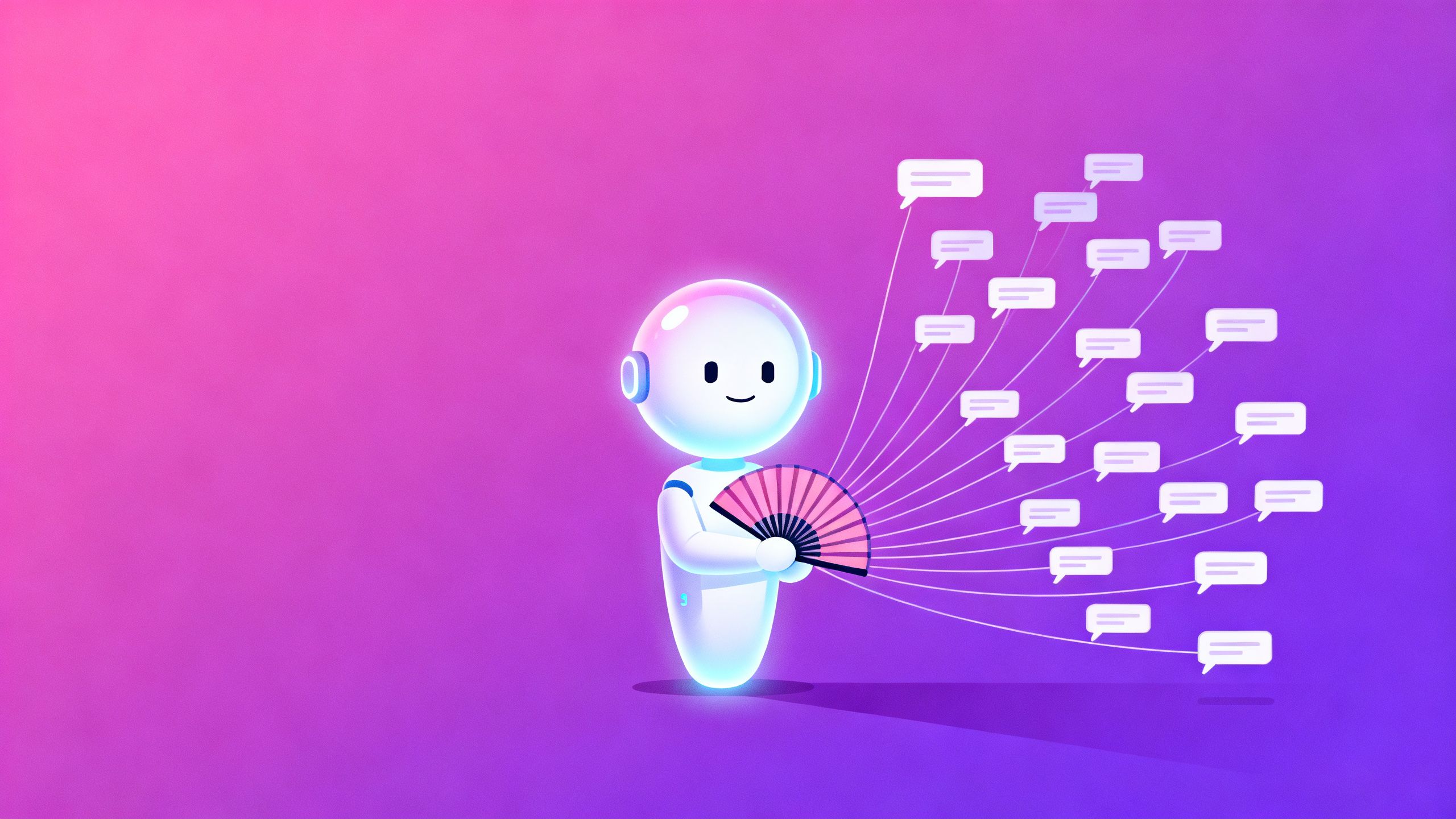
The first pillar of scale is concurrency — handling many conversations simultaneously without them interfering with each other. Each customer needs to feel like they have the AI's undivided attention, even when a million others are talking to it too.
Conceptually, this works because each conversation is kept independent and self-contained:
Concurrency is what lets one AI feel like a million private conversations happening in parallel.
Support volume is spiky. A quiet morning can become a flood the instant a campaign goes out or an outage hits. The second pillar of scale is elasticity — the ability to add capacity the moment it's needed and release it the moment it isn't.
This is where AI's economics beat fixed headcount:
Elasticity means your support capacity matches reality minute by minute, instead of guessing at staffing weeks ahead. For seasonal businesses and viral moments alike, that's the difference between delight and disaster.
Scaling isn't only about how many conversations — it's about keeping each one fast and informed even under heavy load. Two concepts do the heavy lifting here:
Together, caching and durable storage let the system stay both fast and context-aware at any volume — the two qualities that usually trade off against each other when humans are overwhelmed. That persistent memory is also what makes a shared unified inbox possible across millions of threads.
A system that gets slower, sloppier, or forgetful as volume rises hasn't really scaled — it's just deferred the crisis. True scale means consistency: the millionth customer gets the same quality as the first. Achieving that rests on a few principles:
Real scale is invisible: the system feels exactly as fast and sharp at peak as it does at midnight.
Scaling AI doesn't mean removing humans — it means using them where they matter most. A system built to handle millions of conversations still needs a graceful human handoff for the cases that call for judgment, empathy, or authority. At scale, that safety net is designed in from the start:
This is the promise of agentic AI operating at scale: it absorbs the volume so your team can spend its limited human attention where it counts. (See how it comes together in customer support automation and Conversational AI for Customer Service.)
Scaling AI customer support to millions of conversations isn't about one giant brain working harder — it's about concurrency (many independent conversations at once), elasticity (capacity that flexes with demand), speed and memory (fast retrieval plus durable context), and consistency (quality that never sags under load). Wrap that in a graceful human handoff for the cases that need judgment, and you get support that stays fast, personal, and in-context whether ten customers show up or ten million. In 2026, the businesses that thrive won't be the ones with the biggest support teams — they'll be the ones whose AI scales so gracefully that every customer feels like the only one.
Zoom out with What Is Omnichannel Customer Support? and Omnichannel vs Multichannel. Go deeper in Conversational AI for Customer Service, see it applied in WhatsApp Business Automation, and get the numbers in Omnichannel Statistics for 2026. Ready to build? Explore customer support automation and QuickTalk solutions.